「医療系ベンチャー・トータルサポート事業」の総合ポータルサイト
2026.04.28MEDISO:レポート
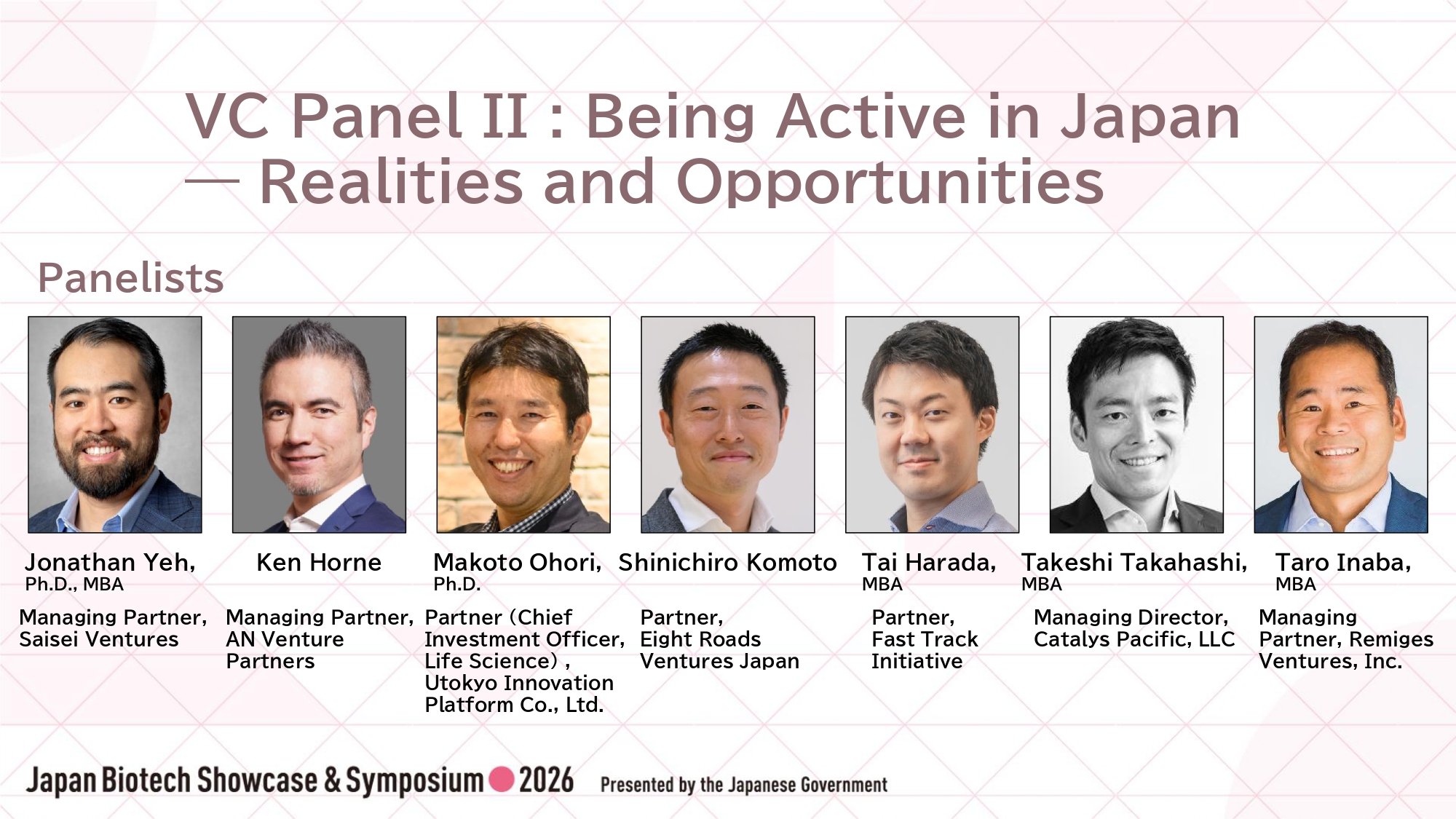
Session Spotlight :Being Active in Japan – Realities and Opportunities | Japan Biotech Showcase & Symposium 2026


英語に続いて日本語が記載されます。
Watch the recordings JBSS: VC Panel Ⅱ:Being Active in Japan — Realities and Opportunities
Related articles: What Would It Take for Japan to Get on the Global VC Map? | Japan Biotech Showcase & Symposium 2026
English
The final session of Japan Biotech Showcase & Symposium 2026 brought together venture capitalists from Japan and overseas who have actively invested, built companies, and executed translational work within Japan.
Rather than offering an external or theoretical assessment, this panel focused on firsthand realities and lessons learned from operating inside the Japanese biotech ecosystem, across universities, startups, and pharmaceutical companies.
“The Science Is There” — Translation Remains the Central Challenge
The discussion opened with a point on which all panelists strongly agreed: Japan possesses world‑class scientific research. This is no longer in question.
However, panelists noted that the process of translating that science into patient value and investable businesses has historically been weak, limiting the growth of the ecosystem. In particular, the lack of a deep healthcare‑focused entrepreneurial layer and the scarcity of visible success cases have made it difficult for projects to clearly define target patients, clinical stages, and value creation.
Two Decades of Accumulation Are Now Showing Results
Long‑term participants emphasized that the environment has clearly evolved. Twenty years ago, discussions about commercialization were rarely welcomed in academic settings. Today, researchers increasingly and naturally speak about how their work might be translated into real‑world medical impact.
Panelists also observed that the quality of Japanese biotech assets has improved noticeably over the past two to three years. Combined with Japan’s geopolitical stability, strong research infrastructure, and capital efficiency, interest from global investors and pharmaceutical companies has risen significantly.
Talent Constraints and a Practical Response
As the discussion deepened, talent constraints emerged as the most acute bottleneck. Japan still has a limited pool of executives with hands‑on experience leading global drug development, which directly affects execution speed and company valuation.
The most practical solution repeatedly cited was the formation of hybrid teams—leveraging Japanese‑origin science while embedding experienced overseas talent in clinical development and management roles. Many panelists shared examples of building companies using this transpacific model.
Structural Friction in Capital Markets and VC Practices
Differences in capital market structures and venture capital practices were also highlighted. In Japan, IPOs are often treated as financing events rather than exits, shaped by a market dominated by retail investors. This frequently leaves companies under‑capitalized.
Panelists contrasted this with US practices such as staged follow‑on financing and a strong bias toward early termination of failing programs. Recognizing time—not capital—as the scarcest resource was identified as an important mindset shift for Japan’s ecosystem.
Japan’s Position in the Era of Mega‑Rounds
The rise of $100M‑plus Series A financings in the US was discussed with caution. While large rounds can accelerate development, panelists warned that excessive capital can undermine efficiency and entrepreneurial discipline.
In this context, Japan’s strengths—capital efficiency, lower cost structures, and high research quality—were reframed as strategic advantages. Rather than replicating US funding models, Japan can pursue a differentiated approach focused on efficient value creation.
Rethinking IPOs and M&A in Japan
During the Q&A, panelists examined why Japanese IPOs and domestic pharmaceutical acquisitions remain limited. A particularly striking observation was that similar assets often generate greater market impact when sourced overseas, reflecting investor bias rather than intrinsic value.
At the same time, this distortion was also seen as creating arbitrage opportunities for investors capable of recognizing value ahead of the market.
Conclusion: Momentum Is Building
The panel concluded with a shared sense that long‑term groundwork is beginning to pay off. The role of players who can connect talent, capital, and institutional structures across borders will become increasingly important.
While challenges remain, panelists agreed that a single major success story could rapidly accelerate progress. Japan’s biotech ecosystem is no longer waiting to begin—it has already entered its next phase.
日本語
シンポジウム最終セッションとして行われた本パネルでは、日本で実際に投資、会社創出、事業化を行ってきた日米のベンチャーキャピタリストが登壇し、日本バイオテックエコシステムの実像と今後の可能性について議論が交わされた。
本セッションの特徴は、グローバルVCの「外からの視点」ではなく、日本の大学、スタートアップ、製薬企業と向き合いながら、現場で“translation(研究から事業へ)”を担ってきた実践者の声が中心となった点にある。
「サイエンスは十分にある」──最大の壁はTranslation
議論はまず、日本のバイオテックをめぐる長年の構造的課題から始まった。登壇者の多くが共通して指摘したのは、「日本には優れたサイエンスがある」という前提はもはや疑う余地がないという点である。
一方で、そのサイエンスを患者価値や投資可能な事業へと結びつけるtranslationの工程が弱かったことが、日本エコシステムの成長を制限してきたという認識が示された。特に、ヘルスケア分野における起業家層の薄さや、成功事例の不足による学習機会の欠如が、長年の課題として共有された。
20年の蓄積がもたらした変化
長年日本に関わってきた投資家からは、「環境は確実に変わってきている」との評価も示された。20年前には、大学を訪問しても事業化の話が歓迎されることは稀だったが、現在では研究者自身が社会実装について自然に語るようになっているという。
さらに、直近2〜3年では、日本発バイオベンチャーや技術シーズの質が目に見えて向上しているとの声も相次いだ。日本の地政学的安定性、研究環境、資本効率の高さを背景に、海外投資家や製薬企業の関心が高まっている点も共有された。
人材という最大の制約と、その現実的な解
議論が深まるにつれ、日本バイオの最大の制約として浮かび上がったのが人材プールの問題である。グローバル創薬や臨床開発を主導してきた経験人材が国内に限られており、そのことが実行力や開発スピードに影響しているという現実が率直に語られた。
その解決策として繰り返し示されたのが、「ハイブリッド型チーム」の構築である。日本の基礎サイエンスを核にしつつ、臨床開発や経営の中核に海外人材を組み込むモデルは、すでに多くのVCが実践しているアプローチとして紹介された。
資本市場とVC慣行の違いが生む摩擦
人材と並ぶ重要なテーマとして、日本の資本市場およびVCの慣行が議論された。日本では、IPOが「Exit」ではなく次の資金調達手段として位置付けられることが多く、個人投資家中心の市場構造も相まって、企業が十分な資金を確保しにくい状況が指摘された。
また、米国VCに一般的な段階的フォローオン投資や、「早く止め、次に進む」意思決定文化が日本では十分に根付いていない点も課題として挙げられた。時間を最大の資源と捉える考え方は、日本エコシステムにとって今後の重要な学習テーマとされた。
メガラウンド時代における日本の立ち位置
米国で一般化しつつある100百万ドル規模のシリーズAについては、必ずしも無条件に肯定されたわけではない。資金規模の拡大は開発スピードを高める一方で、資本効率や起業家精神を損なうリスクもあるという指摘がなされた。
その文脈で、日本の強みとして改めて注目されたのが、資本効率の高さ、コスト構造の軽さ、そして研究品質である。日本は米国モデルを模倣するのではなく、「少ない資本で本質的な価値を生む」独自のポジションを築ける可能性が示された。
日本IPOとM&Aをどう考えるか
Q&Aでは、日本IPOや国内製薬企業によるM&Aが少ない理由にも議論が及んだ。特に印象的だったのは、「同じ技術でも海外資産の方が市場から高く評価されやすい」という投資家の現実的な認識である。
これは日本市場における認知バイアスの表れである一方、VCにとっては裁定(arbitrage)機会となり得るとの見方も示された。
まとめ:日本は「波が来ている」局面にある
議論の最後に、複数の登壇者から共通して語られたのは、「今は長年の蓄積が一つの波となって現れ始めている」という認識である。
人材、資本、制度を横断的につなぐプレイヤーの重要性が高まる中で、一つの象徴的な成功事例が生まれれば、エコシステム全体が加速するとの期待も共有された。日本バイオテックは、課題を抱えながらも、すでに次のフェーズへ踏み出しつつある。
アーカイブ動画: JBSS: VC Panel Ⅱ:Being Active in Japan — Realities and Opportunities
関連記事: What Would It Take for Japan to Get on the Global VC Map? | Japan Biotech Showcase & Symposium 2026
お知らせ:MEDISO
お知らせ:政府支援中核機関
お知らせ:他団体
よく読まれている記事
サポーター募集
医療系ベンチャーを支援する「サポーター」の募集を開始しました。