「医療系ベンチャー・トータルサポート事業」の総合ポータルサイト
2026.04.28MEDISO:レポート
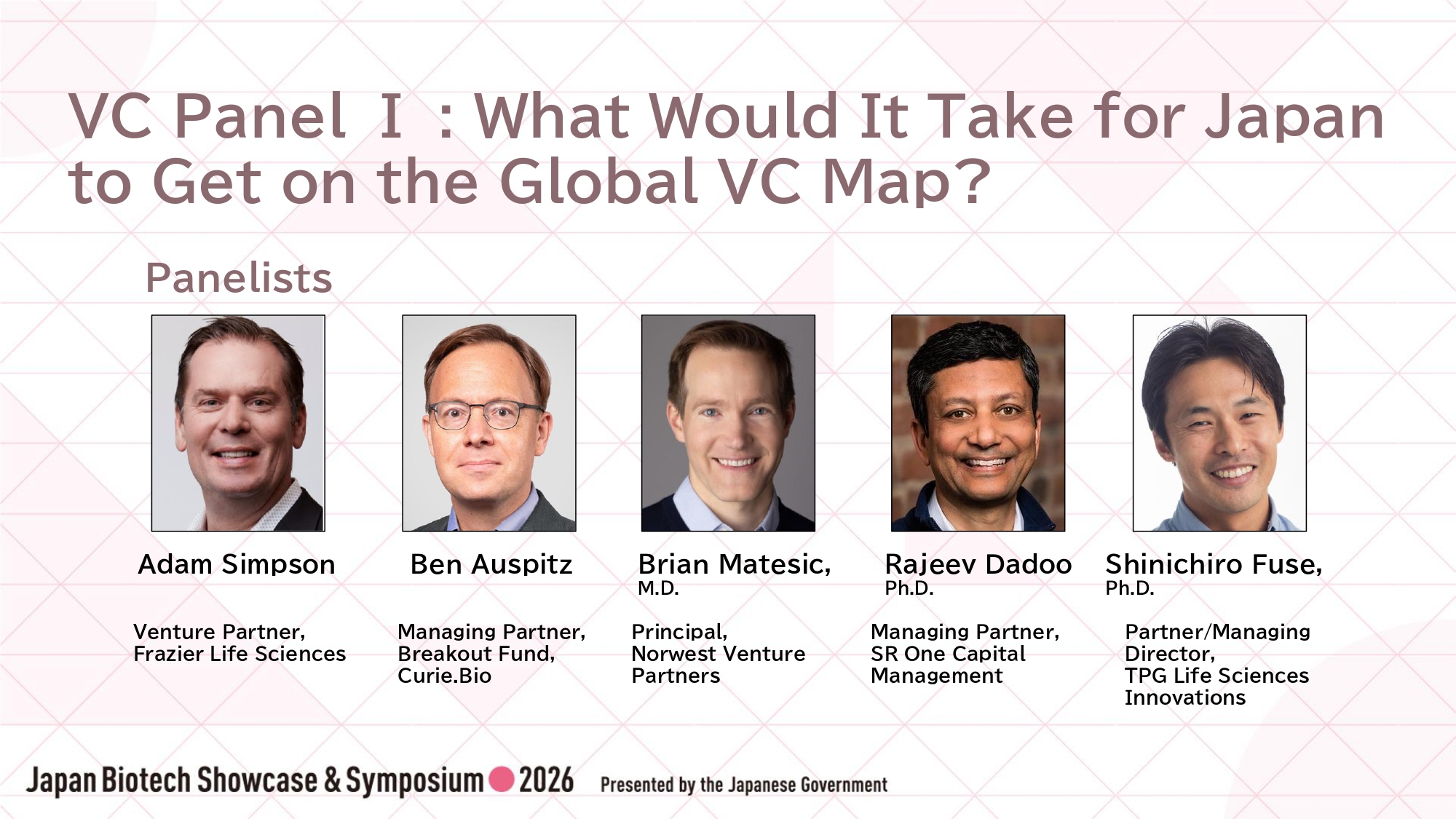
Session Spotlight :What would it take for Japan to get on the global VC map? | Japan Biotech Showcase & Symposium 2026


英語のあとに日本語が続きます。
Watch the recording: JBSS:VC Panel Ⅰ:What Would It Take for Japan to Get on the Global VC Map?
Related Articles: Being Active in Japan – Realities and Opportunities | Japan Biotech Showcase & Symposium 2026
English
At the Japan Biotech Showcase & Symposium 2026, a panel discussion was held featuring leading global life science venture capitalists, engaging in a candid conversation about how Japanese biotech is perceived in the context of global investment and what is expected of it going forward. The session brought together investors with extensive track records in drug discovery and biotech investments across Japan, the U.S., and Europe. They shared practical insights from an investor’s perspective on the current position of Japanese biotech and its next strategic moves.
Japanese Biotech Is Not “Unknown” — It Is “Under‑Visible”
At the outset, panelists discussed their overall perception of Japan. There was strong alignment around Japan’s core strengths: high‑quality, reproducible science; a long and credible history in pharmaceutical R&D; and a stable geopolitical and regulatory environment suited to long‑term biomedical development.
At the same time, panelists emphasized that Japanese biotech is not seen as inferior, but rather as insufficiently visible. Even when strong research outputs and promising assets exist, the pathways for international exposure—bringing these opportunities to global investment decision tables—remain underdeveloped.
Competing with China: Not Speed, but Quality
China was frequently referenced as a point of comparison. While China excels at rapid clinical execution and fast replication of existing approaches, panelists noted that competing with China on speed alone is unrealistic.
Instead, Japan’s opportunity lies in competing on the quality of innovation: pursuing genuinely novel science, generating highly reliable data, and addressing complex clinical challenges such as new endpoints or difficult trial designs.
The Core Bottleneck: Translating Science into an Investable Form
The most consistently emphasized challenge throughout the panel was the gap between strong science and investable company formation. Panelists repeatedly noted that many Japanese projects struggle not due to weak science, but because they are not sufficiently structured as investment‑ready opportunities.
Common gaps include unclear value inflection points, vague paths to clinical proof of concept, insufficient articulation of patient populations and competitive differentiation, and a lack of realistic capital and timeline planning. By contrast, leading global startups are often able to communicate these elements clearly within the first few minutes of a pitch.
Entrepreneurial Asymmetry in the Ecosystem
Another key theme was the limited movement of talent from large pharmaceutical companies into startups in Japan. Panelists attributed this to cultural and psychological barriers surrounding failure.
In major US biotech hubs, failed startups are not career‑ending; instead, they often serve as stepping stones to future success. Panelists shared the view that one highly visible success case in Japan could trigger a virtuous cycle of talent, capital, and know‑how.
The Role of Local Partners and Policy Support
Because most global VCs do not maintain permanent operations in Japan, strong local partners were identified as essential. Japanese VCs and ecosystem players play a critical role in trust‑building, ongoing monitoring, and navigating institutional and regulatory context.
Non‑dilutive public funding programs—such as those provided by AMED—were also highlighted as important factors that materially strengthen the investment case for global investors.
Conclusion: Japan at the Threshold of the Next Stage
The panel concluded that Japan already possesses many of the core attributes required for global biotech investment.
To move to the next stage, however, Japan must continue to develop globally legible business designs, tightly aligned clinical value narratives, and visible success stories. As several panelists noted, a single major success could fundamentally shift global perception. Japan now stands at a pivotal inflection point.
日本語
Japan Biotech Showcase & Symposium2026では、世界トップクラスのライフサイエンスVCを迎え、日本のバイオテックがグローバル投資の文脈でどのように認識され、何が求められているのかを率直に議論するパネルディスカッションが開催された。本セッションには、日米欧で数多くの創薬・バイオテック投資実績を有する投資家が登壇。日本バイオの「現在地」と「次の一手」について、投資家視点から実務的な示唆が共有された。
日本のバイオは「知られていない」のではなく「見えにくい」
パネル冒頭では、グローバルVCから見た日本の印象について議論が行われた。登壇者から共通して挙げられた日本の強みは、高品質で再現性の高いサイエンス、長い製薬・創薬の歴史に支えられた研究基盤、そして地政学的・制度的に安定した国家環境である。
一方で、「日本発バイオが劣っているわけではないが、グローバル投資家の視界に十分入っていない」という認識も共有された。優れた研究成果や技術シーズがあっても、国際的な場で可視化され、投資検討テーブルに上がるまでの導線が弱い点が課題として指摘された。
中国との違い:勝負すべきはスピードではなく“質”
中国との比較も重要な論点として取り上げられた。中国は迅速な臨床開発や既存技術の高速な再現(me‑too)に強みを持つ一方、日本が同じ土俵で競うことは現実的ではないとの意見が示された。
その上で、日本が目指すべきポジションとして、独創性の高い新規サイエンス、信頼性の高いデータ創出、そして新規エンドポイントや難易度の高い臨床設計といった「イノベーションの質」で勝負すべきであるとの見解が共有された。
最大のボトルネックは「投資可能な形」への翻訳
本パネルを通じて最も繰り返し強調されたのは、「良いサイエンスが、投資可能な形(investable form)に整理・設計されていないケースが多い」という点である。
価値が大きく跳ねるポイント(Value Inflection Point)の不明確さ、臨床PoCに至るまでの具体的な開発パスの曖昧さ、対象患者や競合、差別化要因の整理不足、そして資金・時間軸を含む現実的な計画の欠如が典型例として挙げられた。トップレベルのスタートアップでは、これらを初回ピッチの数分で説明できるという指摘もあり、日本企業にとって重要な改善点として共有された。
起業人材とエコシステムの“非対称性”
日本では、大手製薬企業からスタートアップへ挑戦する人材がまだ少なく、その背景には失敗に対する心理的・文化的ハードルの高さがあるとの意見が相次いだ。
米国の主要バイオクラスターでは、スタートアップの失敗がキャリアの終わりを意味せず、再挑戦が前提となっている。一方、日本ではこの循環が十分に機能しておらず、起業人材の層が厚くなりにくいことが課題とされた。登壇者からは、「一つの象徴的な成功事例が生まれることで、人・資本・ノウハウが回り始める」との認識が示された。
ローカルパートナーと政策支援の重要性
グローバルVCの多くは日本に常駐しておらず、ローカルVCやエコシステムプレイヤーの存在が不可欠である点も強調された。信頼構築、日常的なモニタリング、制度理解の補完といった役割において、日本のローカルパートナーが果たす役割は大きい。
また、AMEDなどによる非希薄型資金は、グローバルVCの視点から見ても投資判断を後押しする要素として高く評価されていることが明確に語られた。
まとめ:日本は「次のステージ」への入口にいる
本パネルを通じて、日本はすでにグローバル投資の対象となる素地を十分に備えている一方で、国際的に通用する事業設計、臨床価値への一直線なストーリー構築、成功事例の可視化といった点が、次の成長に向けたカギであることが確認された。
登壇者からは「一つ大きな成功事例が生まれれば、日本バイオの評価は大きく変わる」との見解が共有され、日本はまさにその転換点に立っているとの認識でセッションは締めくくられた。
アーカイブ動画: JBSS:VC Panel Ⅰ:What Would It Take for Japan to Get on the Global VC Map?
関連レポート: Session Spotlight: What would it take for Japan to get on the global VC map?
お知らせ:MEDISO
お知らせ:政府支援中核機関
お知らせ:他団体
よく読まれている記事
サポーター募集
医療系ベンチャーを支援する「サポーター」の募集を開始しました。